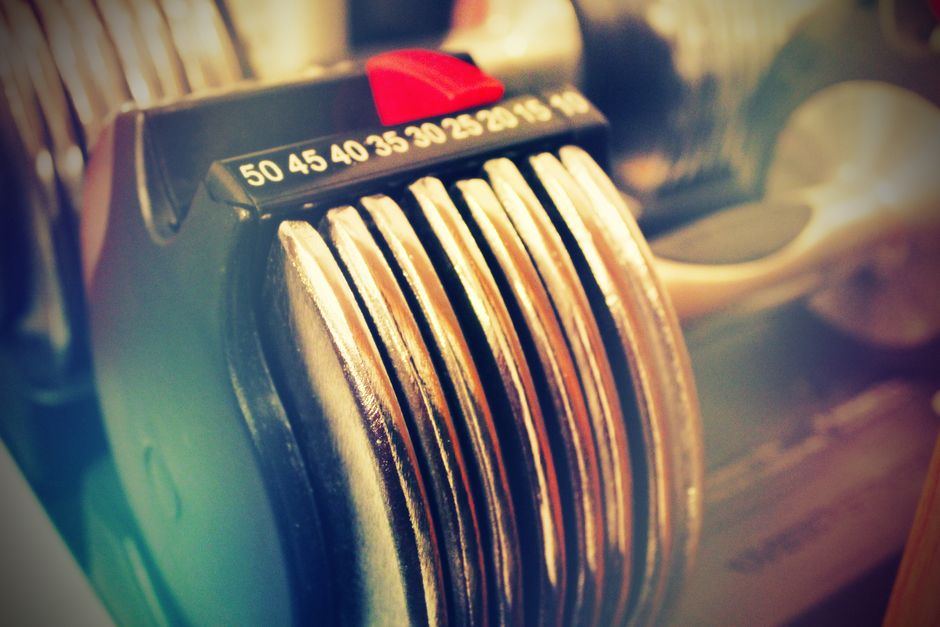
A full rack of weights, without the full rack
Reviewed by the Dumbbell Guide team · last updated 2026-08-11
A basic strength-training routine needs weights spanning a wide range — light enough for shoulder raises, heavy enough for a goblet squat or a bent-over row — and buying that whole range in fixed dumbbells eats up money and floor space fast. Adjustable dumbbells solve that by packing five, ten, or more weight increments into one pair of handles, but the mechanisms that make the swap happen vary a lot in speed, noise, and long-term durability.
The market splits into three main designs: block-style dumbbells that use a selector pin to lock in a weight from a stacked internal block, twist-lock dumbbells where the plates live in a tray and a twist of the handle picks the load, and plate-loaded dumbbells where you manually thread screw collars onto loose plates. Block and twist-lock systems change weight in seconds and are quieter, while plate-loaded sets cost less upfront but take longer to adjust between exercises.
Worth knowing before you buy: adjustable dumbbells are rated by their maximum combined weight per hand, not per pair, and most home lifters never need to go past 50-55 lbs per hand for upper-body work even as they progress. Buying a set with room to grow costs more now but avoids replacing the whole set once you outgrow a lower-capacity option.
Adjustable dumbbells cover most upper-body and isolation exercises, but a real home gym setup usually needs two more things to unlock a full workout routine: a bench for pressing and incline/decline movements, and resistance bands for warm-ups, mobility work, or travel days when the dumbbells stay at home.
Weight range and increments
Check both ends of the range: a low enough starting weight (5 lbs or under) for warm-ups and small-muscle work, and a top end with room to grow. Smaller increments (2.5 lbs) let you progress more gradually than sets that jump by 5 or 10 lbs at a time.
How fast you can change weight
Block-style and twist-lock dumbbells let you change weight in a few seconds by pin or handle twist, which matters most for supersets and circuit training. Plate-loaded sets with screw collars are slower to adjust but typically cost less per pound of capacity.
Footprint and cradle design
Block-style dumbbells have a wider, rectangular profile that can limit certain exercises like renegade rows, while tray-based and plate-loaded designs sit lower and narrower but need a stand or more floor space to store the full set.
Build quality and warranty
Look for a metal (not all-plastic) selector mechanism and a warranty of at least 2-3 years — the adjustment mechanism is the part most likely to wear out or loosen with heavy daily use, so warranty length is a reasonable proxy for how confident the manufacturer is in it.
Dumbbells alone vs. a full setup
Dumbbells cover curls, rows, and presses done standing or on the floor, but bench presses, incline work, and step-ups all need a bench -- without one, a meaningful chunk of a standard dumbbell program isn't actually possible at home.